
A wireless mouse usually feels invisible when everything is working properly. Move it across the desk, click a button, and the cursor responds. That is exactly why a small delay can be so noticeable when something goes wrong.
The cursor may stop for a moment, move unevenly, or respond a fraction of a second after the hand moves. Sometimes the problem disappears after a few minutes. Other times, it keeps coming back and makes simple office work surprisingly frustrating.
Before replacing the mouse, it is worth checking a few basic things. Wireless interference, receiver placement, battery condition, power-saving behavior, and device compatibility can all affect how a wireless mouse performs.
Start With the USB Receiver
For a 2.4G wireless mouse, the USB receiver is the link between the mouse and the computer. A poor connection at this point can look like a mouse problem even when the hardware itself is working normally.
Start by checking whether the receiver is fully inserted. USB hubs and extension devices can sometimes add another variable, so connecting the receiver directly to the computer is a useful test.
Distance matters too. A receiver hidden behind a desktop tower, monitor, or other equipment may not have the same clear path as one positioned closer to the mouse.
MOFii’s rabbit-shaped wireless mouse uses a 2.4G wireless connection with a plug-and-play USB dongle. Its working range reaches up to 33 feet in radius, giving the mouse enough room for normal desktop use without requiring a separate driver.

Check for Wireless Interference
A 2.4G mouse shares the radio spectrum with other wireless devices. In a busy workspace, several wireless signals may be active at the same time.
A wireless keyboard, Wi-Fi equipment, Bluetooth devices, or other peripherals can create a crowded environment. Interference does not always cause a complete loss of connection. Sometimes it shows up as short pauses, uneven cursor movement, or occasional lag.
Try using the mouse in a slightly different position and move the receiver away from large electronic devices where practical. This simple test can help determine whether the environment is contributing to the problem. The mouse may appear to lag only at a particular workstation. That does not necessarily mean the mouse itself has changed.
Battery Level Is Worth Checking Early
A wireless mouse depends on battery power, so an old or nearly depleted battery can affect reliability. When users notice lag, they often start investigating software settings first. Checking the battery is quicker and can rule out one of the simplest causes.
MOFii’s wireless mouse includes a smart power-saving program that places the mouse into standby after about five minutes of inactivity. A click wakes it again. The on/off switch also lets users cut power when the mouse will not be used for an extended period.
That design helps reduce unnecessary battery consumption during normal use. If the mouse has been sitting unused for a while, give it a click and wait briefly before assuming there is a connection fault.

Auto Standby Is Not the Same as Lag
Power-saving behavior can sometimes be mistaken for wireless lag.
A mouse that enters standby after inactivity is supposed to respond after waking. The first movement or click may feel different from continuous use because the device has not been actively transmitting during the idle period.
This is normal behavior for many battery-powered peripherals.
The more useful question is what happens after the mouse wakes. If the cursor responds normally once the mouse is active, the power-saving feature may be doing exactly what it was designed to do. If the mouse continues to freeze or skip during active use, then the cause lies elsewhere.
Check the Mouse on Another Surface
Not every cursor problem comes from the wireless connection. Optical sensors can behave differently depending on the surface underneath the mouse. Highly reflective, transparent, or unusually textured surfaces may make tracking less consistent. Try the mouse on a standard desk surface or mouse pad. If the movement immediately becomes smoother, the surface was probably part of the problem. This is a quick test and does not require changing any software or hardware.
Look at the Computer Port and Connection
A USB receiver only works properly when the computer can communicate with it reliably.
If possible, try another USB port. This is especially useful when the mouse becomes unstable only on one computer or one particular port.
There is also an important point about device compatibility. MOFii’s rabbit wireless mouse uses a USB receiver, so it is designed for computers that provide a suitable USB port. It is not directly compatible with MacBook Pro models or other devices that offer only USB Type-C ports unless the user has a compatible adapter or hub.
That limitation is easy to miss when a product is described simply as “wireless.” A wireless connection does not automatically mean universal hardware compatibility.

A Short Working Range Should Not Be the First Assumption
Users sometimes blame distance as soon as they notice a delay.
In a normal office setup, however, the mouse is typically much closer to the computer than the maximum working range. MOFii specifies a working range of up to 33 feet in radius, which is far beyond what most desktop users need.
If lag appears while the mouse sits directly beside the computer, distance is probably not the main issue. Receiver placement, interference, battery condition, or the USB connection deserve attention first.
Check Whether the Problem Follows the Mouse
One of the easiest troubleshooting methods is to change one variable.
Use the same mouse on another compatible computer. Then, if possible, try another mouse on the original computer.
If the MOFii mouse works normally on another system, the original computer or its USB environment may be contributing to the issue. If multiple mice show the same behavior on one workstation, looking at the computer makes more sense than replacing every mouse.
This kind of comparison is often faster than changing several settings at once.
Quiet Clicks Solve a Different Problem
Not every mouse issue is technical.
In shared offices, libraries, classrooms, and other quiet environments, loud clicking can become distracting even when the mouse tracks perfectly.
MOFii’s wireless mouse uses low-noise buttons designed to produce a softer click. That does not affect wireless latency, but it improves the overall experience when the mouse is used around other people.
The distinction is useful because “comfortable wireless mouse” covers more than connection performance. Tracking, clicking noise, size, power management, and portability all matter in everyday use.
Portability Can Matter for Mobile Work
A smaller mouse is easier to carry between home, office, meetings, and travel locations.
MOFii’s rabbit-shaped mouse uses a compact design that can fit into a bag without taking up much space. That makes it suitable for users who move between workstations instead of keeping the mouse permanently on one desk.
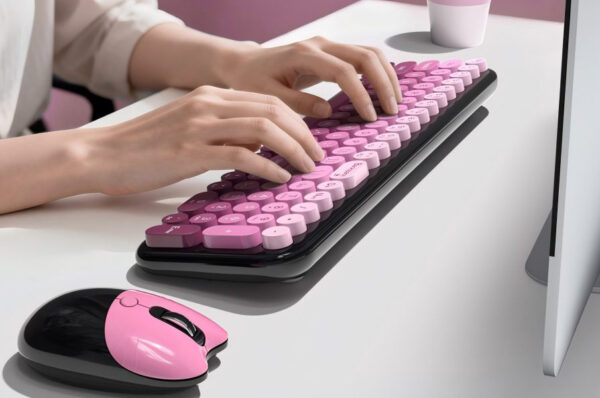
The product also takes a more playful approach to appearance, using a rabbit-inspired shape and fresh colors. For a basic office peripheral, that gives the device a different visual identity without changing the way it connects to the computer.
What Should You Check When a Wireless Mouse Starts Lagging?
When a wireless mouse starts to lag, there is no need to replace it immediately.
Check the USB receiver first. Then look at interference, battery condition, standby behavior, USB ports, and surface tracking. Finally, test the mouse on another compatible computer if the problem continues.
This order keeps the troubleshooting process simple. It also helps separate a genuine hardware problem from an issue caused by the surrounding setup.
For a 2.4G mouse such as MOFii’s, the basic requirements are straightforward: a properly connected USB receiver, a usable battery, reasonable signal conditions, and a compatible computer.
MOFii Wireless Mouse for Everyday Desktop Use
MOFii’s wireless mouse combines practical office features with a more distinctive design.
The 2.4G plug-and-play connection uses a USB receiver and supports a working range of up to 33 feet in radius. Users do not need to install an additional driver for basic operation.
A built-in five-minute auto-standby function helps reduce battery use during idle periods, while the physical power switch provides another way to control power consumption.
The compact design makes the mouse easy to carry, and the quiet-click buttons make it more suitable for shared workspaces where loud clicking can be distracting.
For compatibility, the mouse works with supported Windows computers that have a suitable USB connection. Devices with only USB Type-C ports need an appropriate adapter or hub.

Final Thoughts:
Wireless mouse lag can come from several places, and the mouse itself is not always responsible.
A poorly positioned receiver, crowded 2.4G environment, weak battery, unsuitable USB connection, or simple standby behavior can all look like the same problem from the user’s side. A few basic checks usually make the cause much easier to identify.
For everyday office use, a good wireless mouse needs more than a stable signal. Practical power management, quiet buttons, portable size, and straightforward plug-and-play operation also shape how the product feels during a normal workday.
MOFii brings those details together in a compact 2.4G wireless mouse with a rabbit-inspired design, USB receiver connection, five-minute standby, quiet clicking, and broad support for compatible Windows computers.